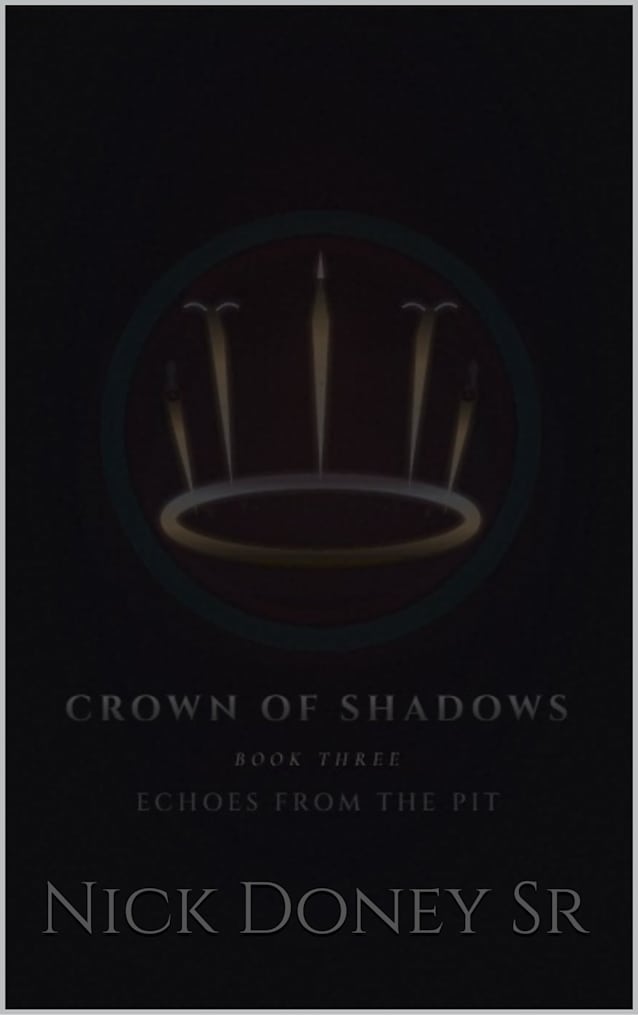
Echoes from the Pit (Crown of Shadows Book 3)
About
Beneath Prague Castle, in a vault that once held silver but now holds the apparatus of obsession, Wenceslaus II stands in his shirtsleeves before a crucible of molten lead laced with royal blood, chanting formulas derived from his father’s marginal notes and the fragments of the Devil’s Bible he still remembers, his body thinning from months of weekly bloodletting while his eyes burn with the conviction that alchemy can reverse what prophecy has ordained. The final volume of the Crown of Shadows trilogy opens not with the sweep of armies or the grandeur of courts but with this intimate portrait of a king consuming himself in pursuit of immortality, a man who inherited an empire already fractured at Marchfeld, who watched his father die on a field that prophecy had named before he was born, and who now wages war not against Habsburg armies or Moravian rebels but against the very nature of the curse that binds three generations of Přemyslid rulers to the supernatural bargains their patriarch struck in a monastery library nearly a century earlier.
The novel expands into the trilogy’s most ambitious and structurally complex narrative, weaving together the political disintegration of the Bohemian super-kingdom with supernatural threats that have compounded across two previous books into something approaching apocalypse. Houska Castle’s bottomless pit, which has whispered and stirred throughout the saga, finally erupts, vomiting demons that possess entire armies and require Wenceslaus to seal the gateway through a ritual that costs him his health in a decline that mirrors historical tuberculosis. The Knights of the Red Star, Agnes’s once-unified order of healer-assassins, fracture irreparably when the aging abbess places her red-star medallion on an altar and declares that protecting the realm and protecting the throne are no longer the same cause, splitting her warriors into loyalists and a shadow faction that will watch from darkness. In Kraków, Polish dukes turn assassination into statecraft as Bohemian daggers are found in noble beds and protests flood the streets. In Silesia, dragon-slaying heirs unearth ancient weapons and challenge Přemyslid authority. In Hungary, claimants ignite border wars against Wenceslaus III’s contested crowning. And in Moravia, Jan of the Plough, the latest inheritor of the peasant-prophet tradition that has threaded through every volume, marches on Olomouc with demands that the old order cannot survive granting.
At the narrative’s devastating center stands Wenceslaus III, the final Přemyslid heir, whose discovery that his mother bargained with rusalka spirits for his conception makes him half-supernatural, his prophetic visions amplified to a clarity that borders on madness, his decisions growing increasingly erratic as he approaches the consolidation of a triple crown spanning Bohemia, Poland, and Hungary. The revelation recontextualizes every supernatural event in the trilogy, suggesting that the Přemyslid bloodline was never merely cursed by the Devil’s Bible but was itself a vessel for forces older than any grimoire, forces that demanded the dynasty’s extinction as the price for its impossible rise. And in the aftermath of extinction, as Habsburgs ascend to claim what the Přemyslids built and lost, the epilogue unfolds like a dream that refuses to end: ghosts of both Ottokars patrol the Vltava, rusalki sing laments that carry across centuries, the Blaník knights settle deeper into their mountain slumber awaiting a reckoning that has only been deferred, and somewhere in the Moravian countryside a ploughman heir of anonymous lineage turns soil that remembers a crown, suggesting that the shadows which climbed faster than ambition have not finished climbing, that echoes from the pit resound long after the voices that created them have fallen silent, and that the story of Bohemia is one that no single dynasty, no matter how brilliant or doomed, could ever contain.